
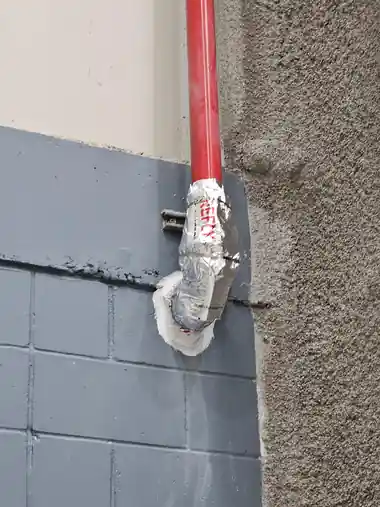
Penetrations are the most common passive fire defect we find on Sydney sites. That is usually not because nobody sealed them, but because the wrong product was used for that service. A product is only compliant when it is installed exactly as it was tested to AS 1530.4, for that pipe material and size, that wall or slab type and that FRL. Here is a quick guide.
Fire collars: plastic pipes
A fire collar is a steel sleeve with an intumescent insert, fixed around a plastic (PVC, HDPE, PEX) pipe. In a fire the plastic softens, and the insert swells and crushes the pipe closed, sealing the hole. Collars are made for specific pipe diameters. They can be cast into slabs or retro-fitted to the underside of a slab or the face of a wall.
- Use for: stormwater, sewer and waste pipes, and plastic conduits.
- Watch for: the right size, the right fixings and the correct side of the wall or slab.
Fire wraps: lagged and metal pipes
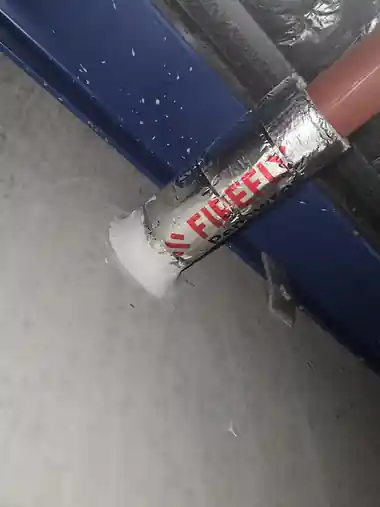
A fire wrap is a flexible intumescent or insulating strip wound around a pipe where it passes through the wall. It is common on copper pipes with lagging, refrigerant lines and sprinkler pipes, where the insulation itself would otherwise burn through.
Intumescent sealants and mastics
Fire-rated sealant fills the gap around metal pipes, single cables and small conduits. It often forms part of a wrap or batt system. The tested system sets the gap width, depth and any backing rod. Silicone from the hardware store is not a fire seal.
Coated fire batts: cable trays and mixed services
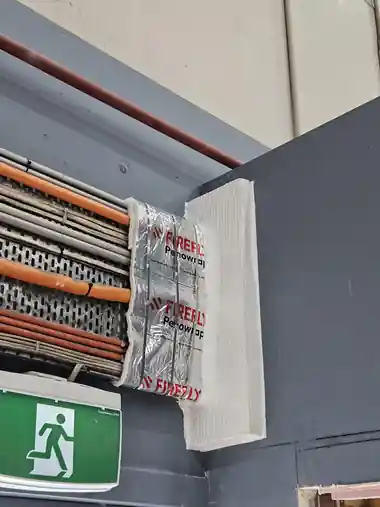
For large openings with cable trays, bundles or several services, a coated fire batt (mineral wool board coated with fire-rated paint) is cut to fit and sealed with mastic. Batts are easy to re-enter when new cables are added later, which is why they are popular in risers and comms rooms.
Ducts
Ventilation ductwork through fire separations usually needs fire dampers, installed by the mechanical contractor. Where the duct itself must be fire rated, it needs fire spray or a duct wrap system. Gaps around dampers and ducts still need sealing to the damper manufacturer's tested details.
The rules that matter on every job
- Match the tested system: same product, service, size, substrate and FRL.
- Label each penetration and record it, as described in AS 4072.1.
- Photograph before closing up, because certifiers and fire safety auditors will ask for evidence.
- Don't mix brands within one seal unless the test data allows it.
Need a single contractor to seal all trades' penetrations and hand over one register? That is what our penetration and fire seal service does.
Need this priced?
Send your drawings, fire engineering report or a few photos. We'll come back with a fixed quote, the tested system we'd use, and an installation certificate at handover.